
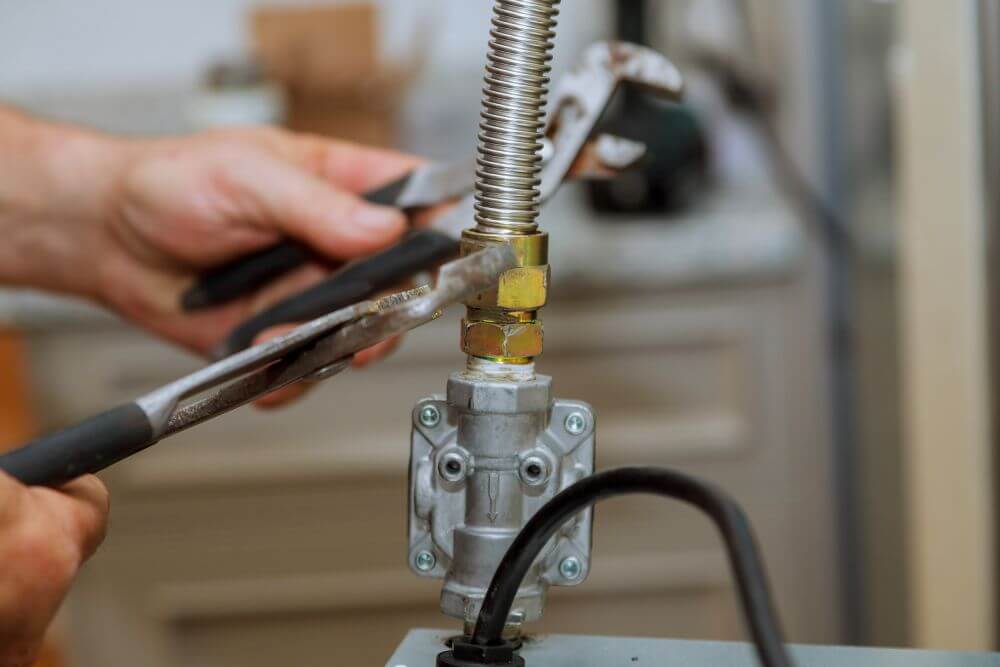
01. Survey
Appliance by appliance
The system is surveyed with a gas detector, joint by joint, so the repair addresses what is actually leaking rather than what is easiest to reach.
Gas Emergency? Call 911 First
If you smell gas, leave the building and call 911 and National Fuel before anything else.
Once the property is safe, we trace and repair the line. The system is surveyed with a gas detector appliance by appliance and joint by joint, repaired in approved materials, then pressure tested and each appliance checked for correct combustion before we leave.
If this is happening right now, start with emergency plumbing in Buffalo and Erie County.
Suspected leaks and damaged connectors.
Leave immediately, avoid switches and flames, and call your gas utility first.
We inspect connections and explain safe next steps before work begins.
We test the repaired system and document any follow-up needs.
Warning signs
Watch for these common symptoms. If you notice any of them, request an inspection before the problem gets worse.
A sulfur or rotten-egg smell requires leaving the area and calling the gas utility.
A supply or connection issue may prevent a gas appliance from operating.
Hissing can indicate escaping gas and should be treated as urgent.
Rust around a connection.
Construction or impact near gas piping should be inspected before use.
A line that repeatedly loses service needs professional diagnosis.
A smell of gas is not a plumbing call first. Leave the building, take everyone with you, and call National Fuel or 911 from outside. Do not touch switches or anything else electrical on the way out. A plumber repairs the line once the utility has made the property safe.
Confirming the utility has been involved where there has been any smell of gas is not an optional step, and everything else follows it.
01. Survey
The system is surveyed with a gas detector, joint by joint, so the repair addresses what is actually leaking rather than what is easiest to reach.
02. Scope
The affected section is isolated, and the scope, the permit position and the cost are explained before any work starts.
03. Prove
The system is pressure tested, then each appliance is relit and checked for correct combustion before we leave.
What we handle
From small repairs to full replacements, here are the specific services included under gas line repair.
Inspect accessible piping and connections after the area has been made safe.
Learn moreUndersized piping left over from an appliance upgrade is the most common finding on this job, and it shows up as poor performance rather than a leak, which is why we survey the whole system rather than just the joint that was called in about.
Learn moreTrace accessible lines and identify damaged or concerning sections.
Learn moreExplain any required follow-up, permits, or utility coordination.
Learn moreHow it works
You always know what happens next, from your first call to a clean, tested, finished job.
Tell us what is happening and where, and we will arrange a visit.
Symptoms, the age of the installation, and a photograph if you have one. It decides what comes off the van.
We find the cause rather than the symptom, and tell you what it is in plain language.
You get clear options and approve the plan before any repair or replacement begins.
The work is completed, tested under normal conditions, and the area left clean.
Your options
On gas piping this is rarely a cosmetic choice. A single failed joint or one corroded length can be cut out and replaced; a run corroding along its length is a different job. The pressure test after the work is what tells you which one you had.
| Factor | Repair | Replace |
|---|---|---|
| Condition | Best where one joint or one length has failed and the rest tests sound. | Best where corrosion or damage runs the length of the pipe. |
| Age | Reasonable where the installation is otherwise in good order. | Often the call on old black iron that has been patched before. |
| Safety | Only where a pressure test proves the remaining pipe holds. | Where a test fails, or where previous repairs have stacked up on the same run. |
| Access | Easier where the run is exposed in a basement or utility space. | Worth it where the pipe is buried in a wall or a slab and will not be reached again cheaply. |
| Permit and inspection | Alterations generally need a permit and an inspection either way. | Same requirement, and the inspection then covers the whole new run. |
| Long-term cost | Lower up front, on a run that may want attention again. | Higher up front, and the test at the end covers everything replaced. |
We do not diagnose remotely. A technician inspects your system on-site before recommending repair or replacement.
Lazy yellow burners instead of crisp blue, soot marks around an appliance, or condensation running down the inside of nearby windows are combustion problems. They are not cosmetic, and they get checked as part of any gas work.
Gas work is permitted work. The permit position is part of the scope you are shown before anything starts, along with the documentation you are left with afterward.
Headaches, nausea or drowsiness that improve when you leave the building is a carbon monoxide warning. That needs emergency services, not a plumber, and it needs them from outside the building.
Leave the building. Do not switch anything on or off on your way out. Call 911 and National Fuel from outside. Call us once the property has been made safe and the repair is the next step.
Call After the Property Is SafeWhere the gas shutoff is, and what turns it, before the night you need it.
Old uncoated brass connectors behind ranges and dryers are worth replacing on sight.
A bigger appliance on the old pipe shows up as poor performance long before anything else.
Repairs, replacements and emergency work for Buffalo homes, priced before the work starts.
Premises that trade, back in service with the least downtime possible and documentation for the file.
Black iron running through damp basement walls and sitting against masonry is the norm in the older housing here, and that is exactly where corrosion shows up. Add decades of appliance changes done by whoever was available at the time, and undoing previous work is a routine part of the job rather than an exception.
Why choose us
Why Buffalo homeowners and businesses call Buffalo Emergency Plumber for gas line repair.
Work is focused on plumbing repair and replacement across Buffalo and Erie County.
You get a structured inspection, plain-language findings, and approved work before we start.
You approve the scope and cost before any repair or replacement begins.
We serve Buffalo and nearby communities across Erie County.
Standard diagnostic tools and common replacement parts used on-site.
Pricing
There is no price list for this work, because what it costs follows the job. These are the things that move the number. You get the figure before anything starts.
A single valve or fitting is a different job from replacing the run it sits in.
A weeping joint is less involved than a failure that has already done damage.
Part costs vary by material and size, and by whether they are on the van.
Crawlspaces, finished walls and ceilings all add time before the work starts.
Time to locate the cause is part of the assessment and estimate.
After-hours or emergency visits may carry an additional service charge.
Some work needs a local permit, and that is included in the figure you are given.
Request an assessment and we will explain the scope and cost before any work begins.
Service areas
We serve Buffalo and the surrounding communities across Erie County, NY.
Leave the building without touching switches or phones, then from outside call 911 and National Fuel Gas. The utility shuts the supply and makes the property safe. Repairing the house piping afterward is our part of the job, not the first step.
At the meter, usually outside or where the service enters the building, with a valve that turns a quarter turn across the pipe. Individual appliances also have their own shutoff nearby. Find both before you ever need them.
Generally everything downstream of the meter: the piping through the building and the connections to each appliance. The service line and the meter belong to the utility.
Alterations to gas piping normally require a permit and an inspection, and the inspection is what verifies the pressure test.
It is not worth the risk. Connector type, sealant, sizing and testing all have specific requirements, and the failure mode here is fire or carbon monoxide rather than a leak on the floor.
Incomplete combustion, which can produce carbon monoxide. Natural gas should burn with a crisp blue flame. Soot marks around an appliance say the same thing, and both need looking at promptly.
It depends on the job. What sets the price for gas line repair is how bad the failure is, the parts it needs, and how much has to be opened up to reach the work, so it is quoted after looking at it rather than from a price list, and you get the figure before anything starts.
Traced, repaired in approved materials, pressure tested and documented, across Buffalo and Western New York.
Call (716) 721-0115 NowTell us what is happening and we will call you back. Name and phone number are all we need to get started.